

It must be simulator month because we’re absolutely swimming in them. Figuratively, until Swimming Simulator or something equally banal turns up in the inbox. Today, I’ve got a hankering to run a nightclub in Disco Simulator. Coming from Games Incubator and Frozen Cave Studio, it’s a functional but tedious entry into the genre. It’s got some charm but lacks the depth to truly stand out from its contemporaries.
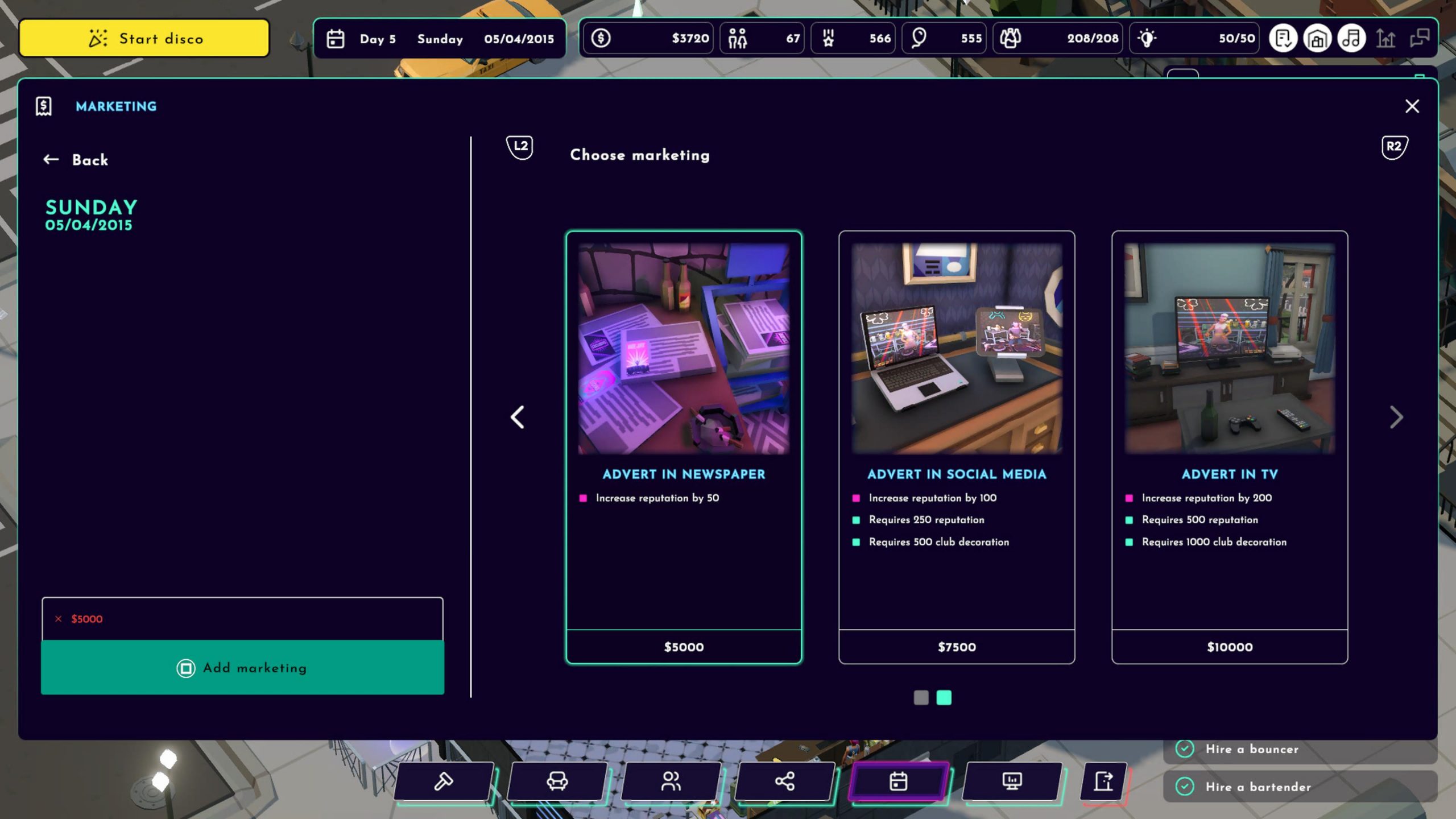 Disco Simulator‘s management tools are not particularly deep. Each level starts with a blank canvas. Before you open, you’re required to have a dance floor, rest furniture a bar, bouncers and bar staff. From there, you can open for business and deal with any events that transpire during business hours. These are all mostly linked to maintenance. Toilets get clogged, glasses get smashed and alcohol is spilled. Between nights, you can keep the bar stocked, upgrade the décor and staff up. You can also arrange nightly events, although these come with certain conditions to meet before hiring a DJ.
Tidying up is as simple as clicking on the notification and dealing with it manually. Some of these can take time and these do build up. In the early stages, it can make things feel a little hectic and I definitely felt like it was keeping me busy. Other events become available like celebrities drinking at the club. How you handle those can influence your reputation and your money. There’s only a handful of these so you’ll see them repeat quite often. The outcomes don’t alter so there’s always a best solution for them.
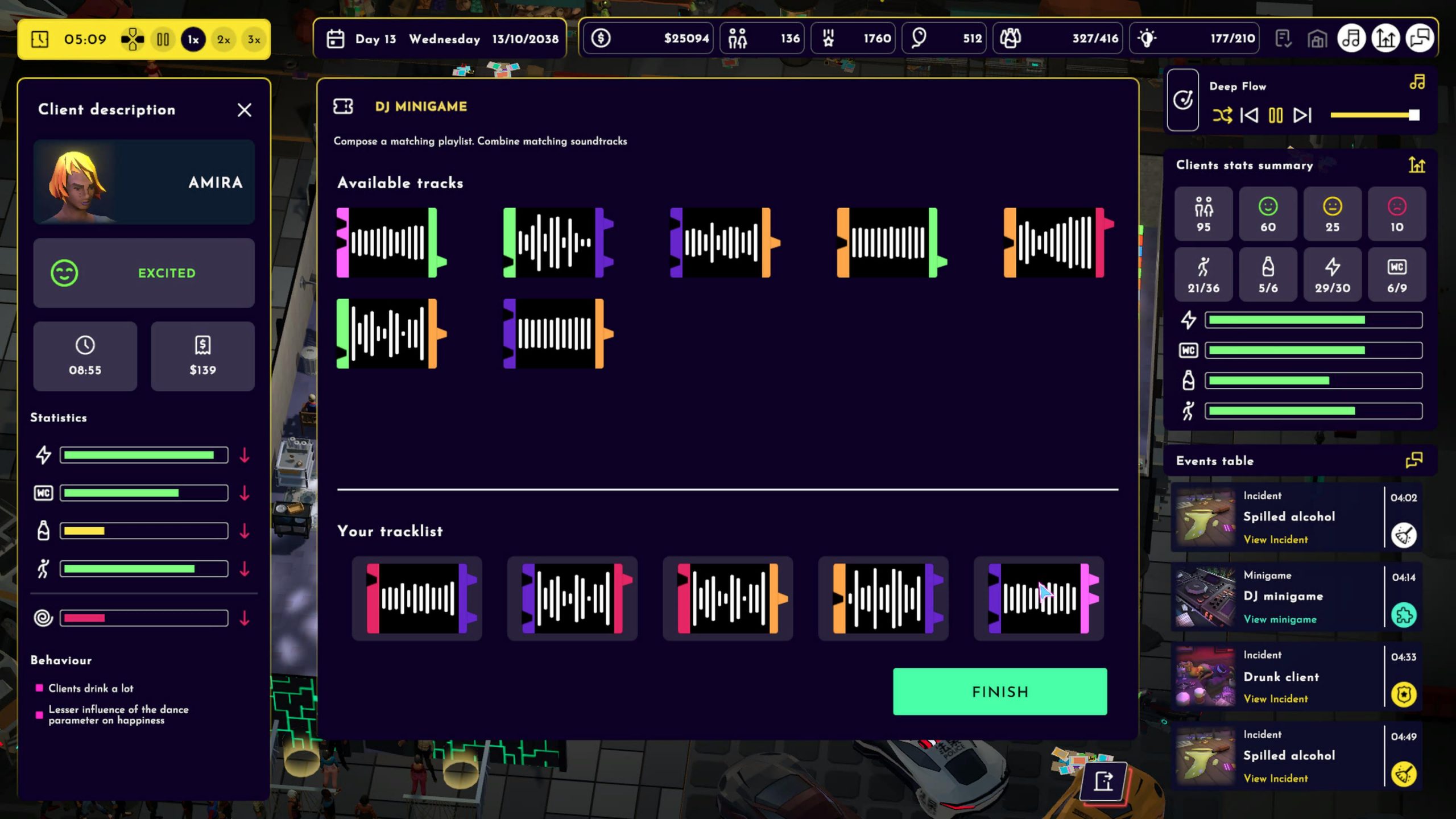 Lastly, there’s little diversions related to the main professions. You can handle ID checks for the bouncers, mix drinks for the bartenders and work the DJ turntables. Correctly performing these gets you extra money or reputation that ultimately impacts how many clients you expect to bring in. It does lead to repetition but having something do do whilst the game simulates the night keeps things active.
Money can be used to outfit the club with cosmetic touches and the upgrade tree, whilst short, does provide improved working stations. Having bars that can be staffed with two or more people can keep the drinks flowing. Providing more bodies on the door allows for more clients to enter. Each client has their own needs and, whilst you could micromanage that, I never felt the need.
Ultimately, reputation and your club’s decoration level are king. They dictate your expected footfall. Clients may leave unhappy but they’ll be back tomorrow, providing your reputation holds. To be honest, reputation never felt like an issue. Events were frequent enough to keep it boosted and one manager’s perks will keep it at a high level.
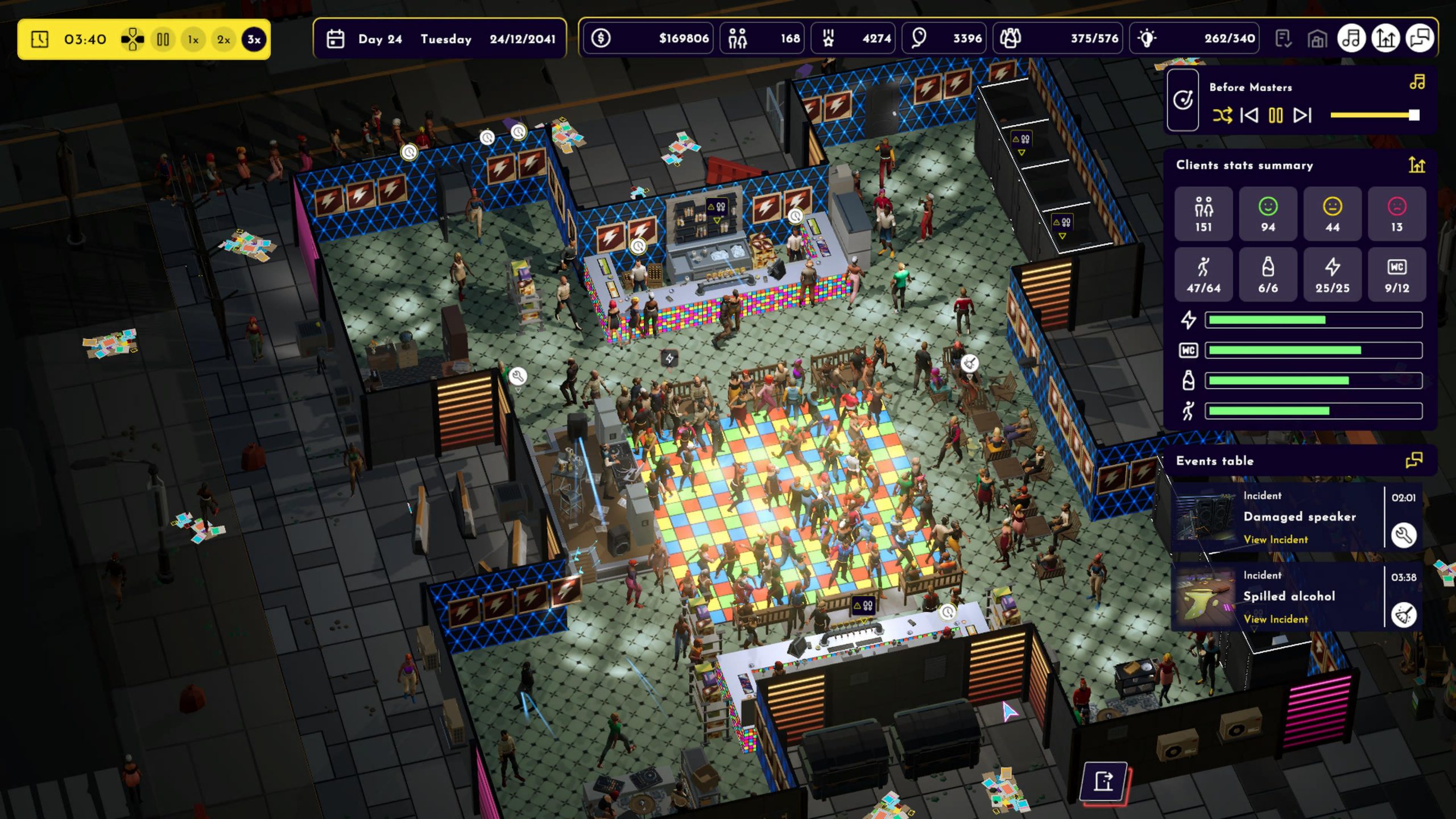 It’s rare for the game to plunge me into a financial hole. Clubs with high rent figures can push it close but Disco Simulator wouldn’t let me spend money I didn’t have. Profit was real easy to come by and the campaign, whilst tedious, had very little stakes. Even when I did into the red, it wasn’t an immediate failure. I did enjoy gaming the system. Early on, I was prioritising bar sales and lowering ticket prices to get people through the door. If I needed extra decoration points, I’d plaster the walls with posters.
As such, the nine clubs to complete tended to go the same way. Even with different criteria like a clientele that preferred to dance, I’d get the win requirements met inside a month. Once I automated the maintenance, I could generally put the controller down and wait for the inevitable victory. There is a creative mode for each level but, as I’ve no pressure to change up my gameplan, it doesn’t offer much. You can’t set your starting budget so those early days of operation largely go the same way. The campaign pushes you into a clear endgame so that freedom doesn’t really entice me.
The presentation is fine. The clientele is diverse and colourful. The clubs start pretty bare but you can add the odd flourish to the walls and floors. You can also build partitions if you, for example, want to keep staff areas away from the public. Without them, they’ll gladly wander in looking for a place to sit down. The music is very royalty free with some basic club music and dubstep to lend a little flavour. As far as I can tell, the footfall of the club is accurate with each person given a name and their own stats. That’s novel, although I didn’t get attached to any of them.
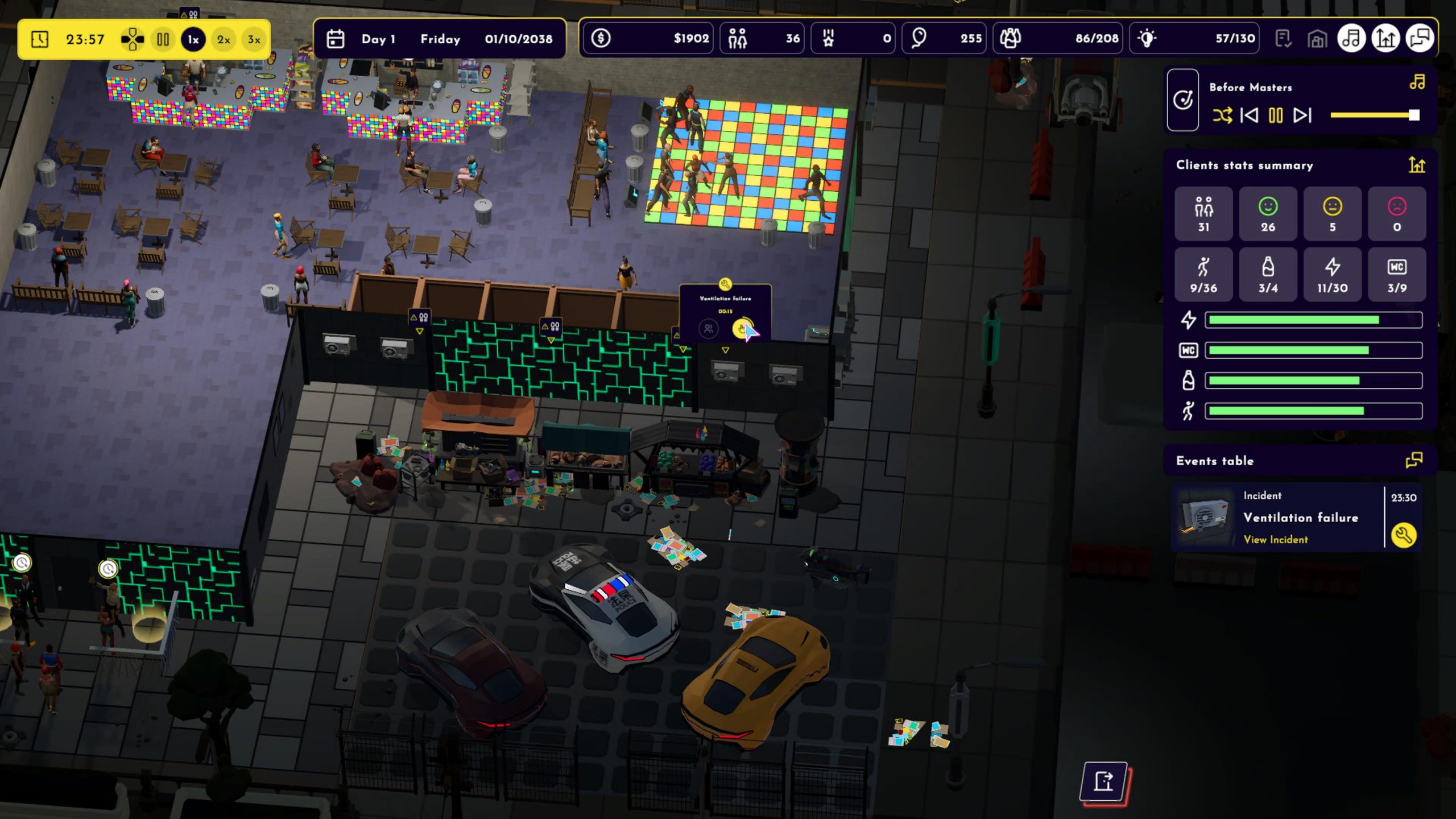 The interface worked well enough, I did find the mouse pointer would get lost in the mass of dancing customers. You can speed the time up and I did appreciate that minigames drop that back to the default setting so you have time to complete them. Alerts have their own pings with the night events having their own distinct warning so you can easily hear them out.
I do find placing objects like security cameras can be fiddly. The controls to rotate them aren’t always responsive and I don’t get much feedback in terms of what I’m doing wrong. To a lesser extent, placing paintings on walls can suffer from the same issue. The screen can be busy with all the meters displayed but it does keep all the key information at hand. It can obscure some of the maintenance events but clicking them on the sidebar brings them into view.
I think what I’m missing from Disco Simulator is a real sense of variety. Not just in how you build a space but how to really manage it. Every location just falls into the same pattern and I rarely found myself struggling to build the club up. To the game’s credit, whilst you can automate a lot, there’s always some interactivity to deal with. That doesn’t quite diminish the repetition and I ran out of things to do relatively quickly.
+ Business hours can feel very active and busy.
+ The campaign has some interesting locales.
+ Fairly easy going.
- The lack of jeopardy makes for a plenty of tedium.
- Each level starts you at square one.
- Creative mode feels redundant.