

We’re sure that if you asked David Doak (Golden Eye) and Steve Ellis (Timesplitters) twenty-five years ago what they would be making today, neither of them would have guessed they would be releasing Beyond Words. Just as Balatro took poker but filtered it through an addictive-roguelike structure, this game is doing the same thing with Scrabble, the popular word-based board game that makes you throw tiles at your brother’s head.
Now this might sound like a bit of a no-brainer. Take ‘X’ and turn it into a roguelike. It’s a popular formula these days. And Scrabble obviously seems like a good fit. That said, Beyond Words wasn’t the first game to do it. Word Play and Wordatro both did it last year, and WordUp did it first in 2024 (and is excellent by the way).
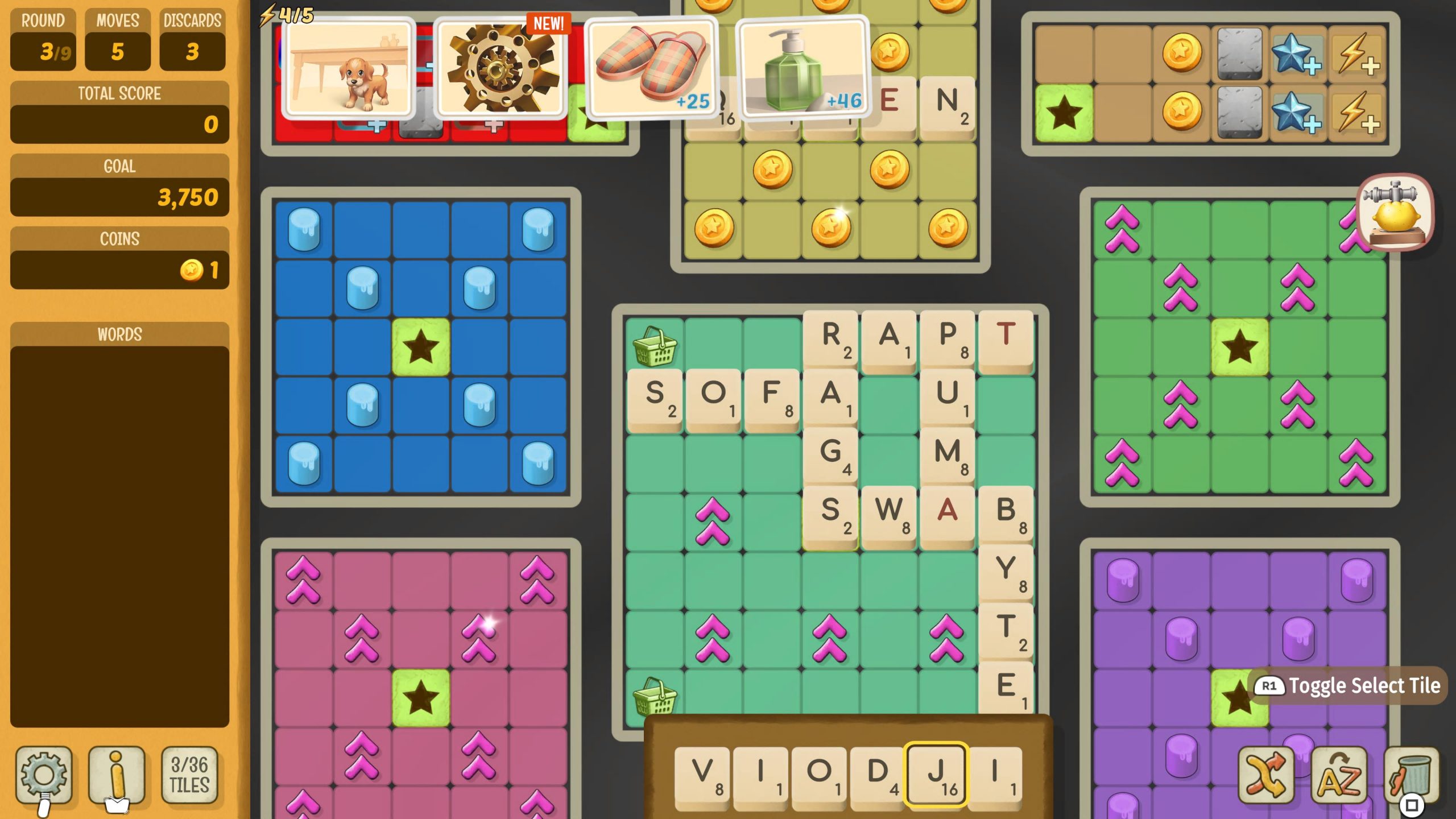
The idea is straightforward enough. You’re given a board and a set of letters on tiles. You place the tiles to make words, and each letter has a point value. These values combine to score the word, and, hopefully, you’ll hit that round’s score target within five words.
However, along the way, you’ll earn coins, and these can be spent on upgrades for that run (essentially the same as the jokers in Balatro). Generally, these will allow you to gain additional points, increase multipliers (essential for keeping up with the exponentially increasing score targets) or offer other useful perks. And as with Balatro, you can order these upgrades, known as Power Cards, to get the most use out of them (simply put, you want your point increases at the left, point multipliers next and then overall score multipliers last).
You also get Boosters, which offer quick one-time perks such a levelling up the score of words of a certain length or allowing you to add multipliers and other effects to specific tiles.
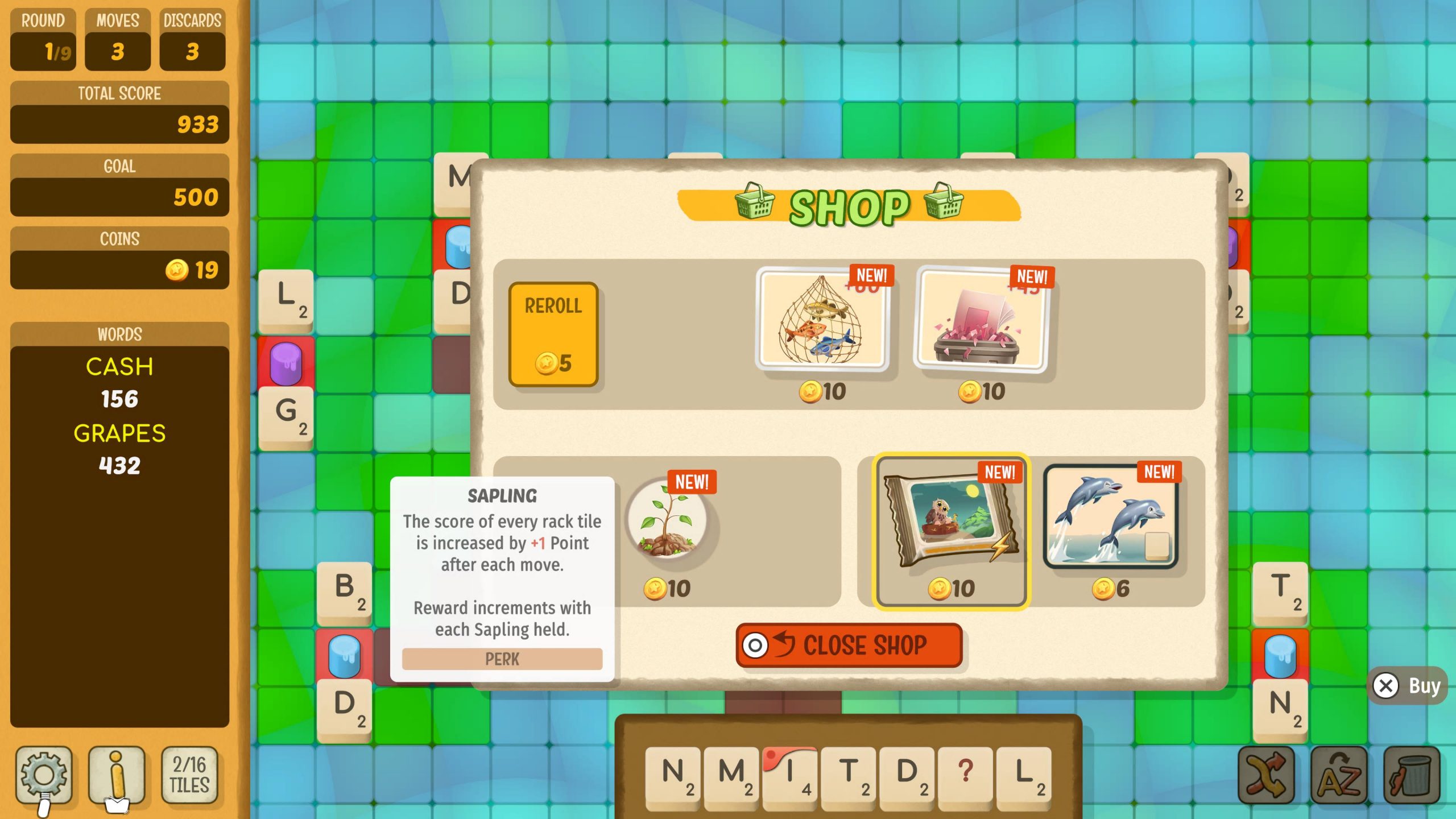
Success very much depends on your ability to pick out words (thankfully, I’m still all-in on Wordle and so this is the easy bit for me) and how lucky you get with these Power Cards. Grab something that adds +100 points to your score and get multipliers that have the scope to grow during your run, and you’ll be on your way to beating the nine rounds each board offers. Get a bad selection of upgrades and you may as well restart because not even a Countdown champion will be able to complete a run with bad luck.
Every third board is a ‘boss round’, and all that means is that something bad is going to be applied to your ability to score. Limits on word sizes, directions and upgrades. That kind of thing. Again, these are kind of random. Get bad bosses, and you can expect to eat shit on that run. That said, we had a boss effect that meant only words of eight letters or more would be scored, which is kind of tough given that your rack only holds seven tiles, but somehow we beat that one, and it was actually exhilarating, so the game can definitely foster some real dopamine candy for your brain.
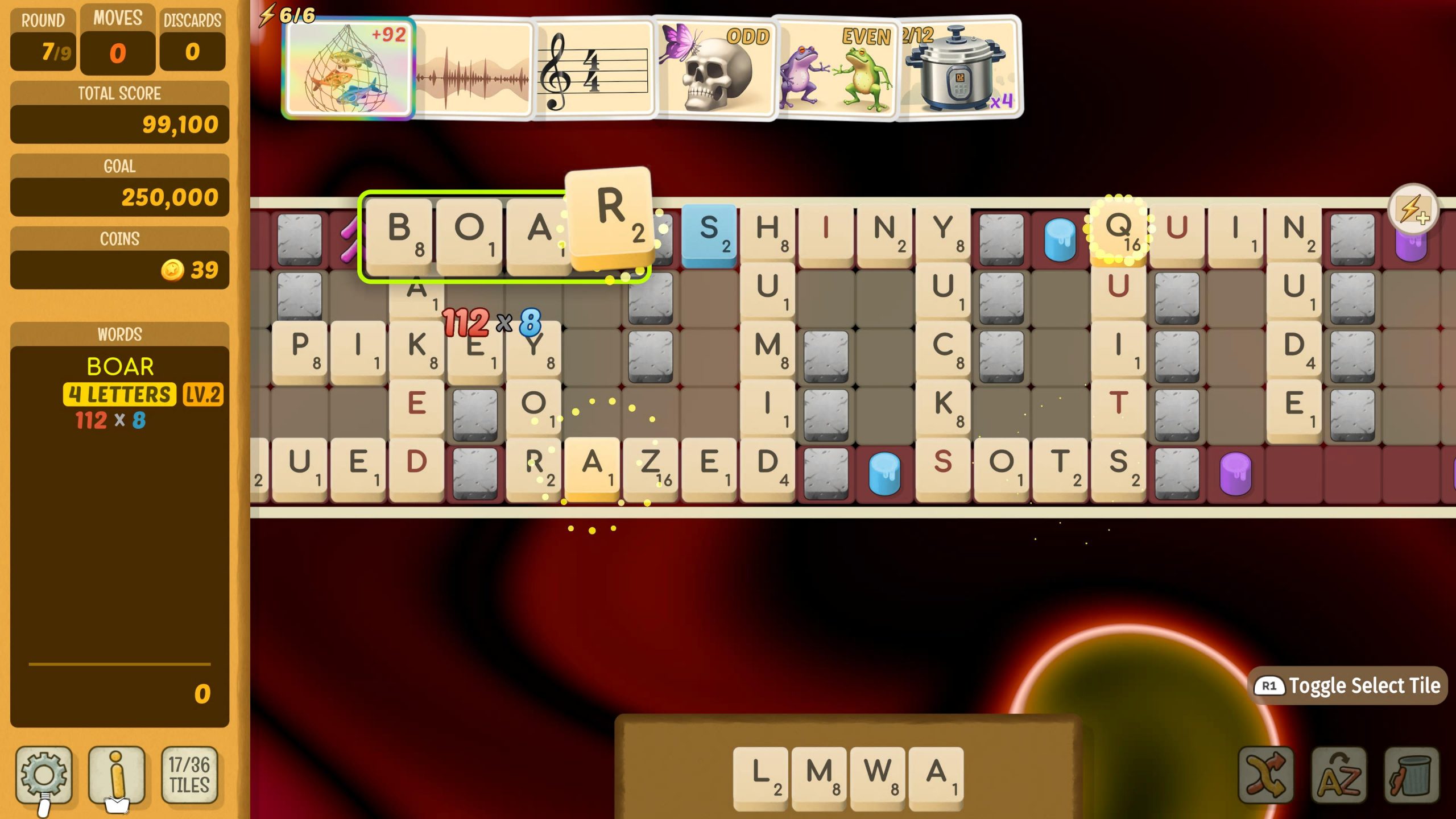
Other bosses have stopped us in our tracks, though and sometimes, as with Balatro, that can seem a little bit unfair. So yes, the RNG gods will need to be appeased with this game.
The game has forty stages each with their own boards, some of which are relatively plain while others can either be shaped in weird ways, add obstacles that need to be destroyed in order to access other areas or have hazards in them such as squares that reset your multiplier to zero or have viruses that increase the value of your tiles but can also destroy them. So there is a lot of game on offer here and, for the most part, it’s pretty enjoyable but we did start to get a bit fatigued by it as it’s a lot of the same thing and the complexity of the levels only increases, making later stages flow a little less well as you’re forced to take snaking paths with 2-or-3 letter words or work around other obstacles.
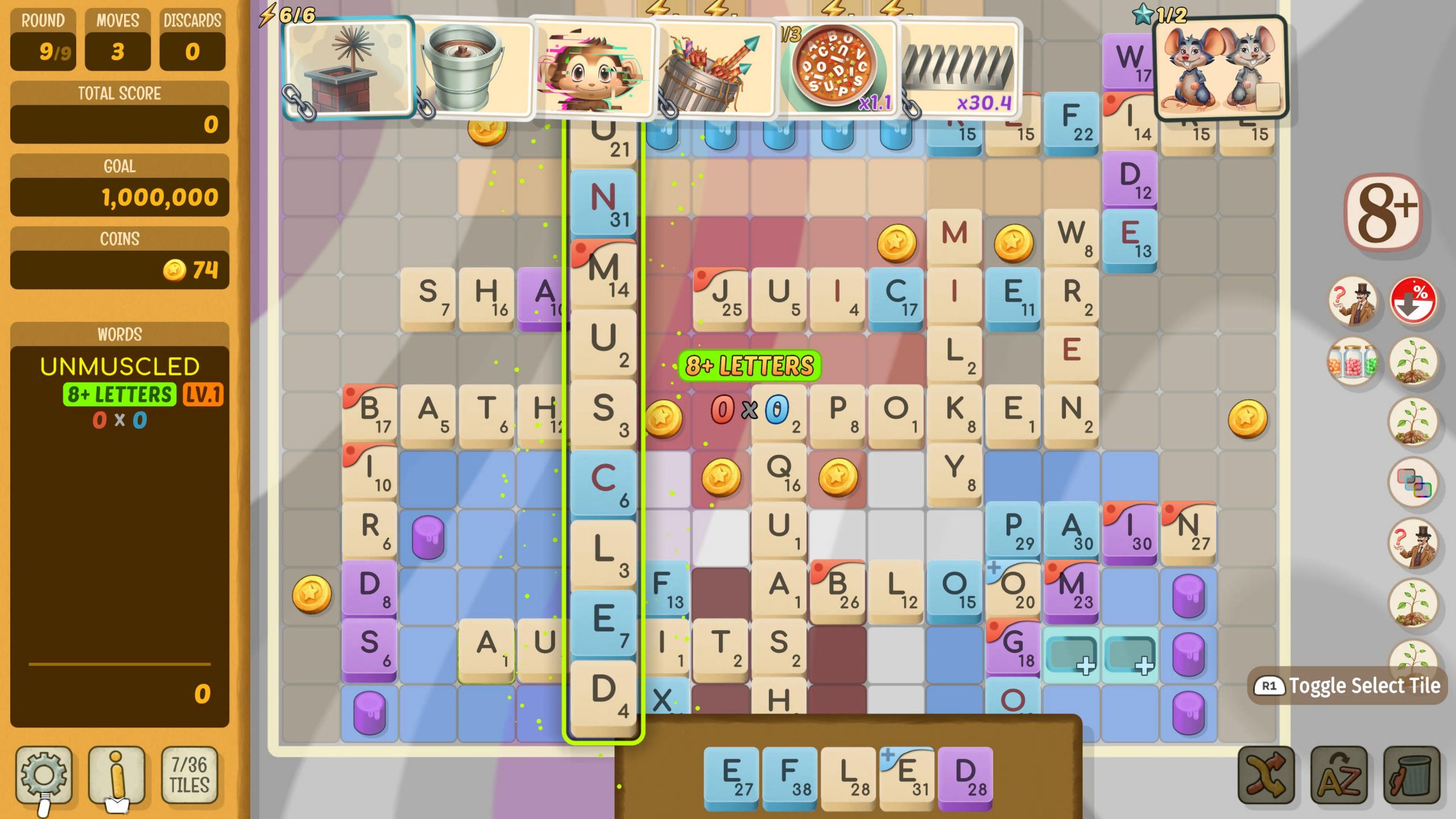
Visually, the game does a good job of presenting everything clearly. There isn’t a ton of personality on show here, but it doesn’t get in your way either. Meanwhile, the music is inoffensive enough, but this also would work very well on silent with a podcast or something going on. The instructions are well-presented too and the controls are decently functional, so the game does let you get on with it rather than fighting you like so many PC ports can do these days.
Overall, Beyond Words works well. It can be a bit too much of a good thing, but it’s surely a good thing nonetheless. Puzzle fans, or people just looking to work their brains a little, should be satisfied with it, and while it’s not quite up there with Balatro in terms of fun or addictiveness, it’s not miles off either. The overall structure could maybe do with tightening up, but if you play this slowly over weeks and months (rather than cramming it for a review), it should make for a game that is good for dipping in and out of.
+ Can be addictive and satisfying
+ Clean presentation
- Runs are at the mercy of the RNG gods
It’s good in an inoffensive Words With Friends sorta way but it dilutes the Balatro formula that bit too much.